


Category
Security
Truck restraint systems at the dock: rotating hooks, vertical barriers or wheel locks?


Frédéric Daniel Juneau
With more than 10 years of experience in the equipment field
At the loading dock, a heavy goods vehicle leaving too early can cause a serious accident: a forklift falling into the void, an injured employee, lost goods. Vehicle restraint devices are used to prevent this scenario. Each device immobilizes the trailer against the dock throughout the entire handling process, from loading to unloading. Canado Nacan Équipements Rite-Hite offers three types of Dok-Lok products: the rotating hook, vertical restraint barriers, and wheel locks. Here's how each type of restraint system works and how to choose the right one for your docks.
The 5 key points
- The restraint devices prevent the truck from leaving during operations.
- The rotating hook engages under the rear impact bar (RIG) and holds it in place.
- The VBR barrier pushes the RIG upwards; it is ideal when the tractor remains hitched.
- The rear tire lock accepts the widest variety of convoys, including those with a liftgate.
- The CNESST reminds us that the stability of the semi-trailer must be ensured, for example with a chock and the brakes.
Why hold the trucks at the dock?
According to Rite-Hite, a dock leveller can see more than 100,000 forklift passes each year. Each pass assumes the vehicle remains precisely in place, without risk to employees. Separation accidents between the vehicle and the dock can take several forms:
- premature departure: the driver leaves before the end of operations;
- the sliding of the semi (the "walk"), caused by the repeated passage of the trolleys, is a risk not to be neglected;
- the collapse of the landing gear of a detached semi-trailer;
- the semi-trailer that tips over or lifts itself up.
The CNESST and Via Prévention recommend ensuring the stability of the semi-trailer, for example, with a wheel chock, deflated suspension, and the brakes ( CNESST document on platform trailers ). The IRSST has also published a study on the design of wheel chocks ( IRSST report R-863 ). A restraint system goes beyond a chock: it locks the trailer and integrates with the dock door controls. It is a key element of workplace safety and employee protection in the warehouse.
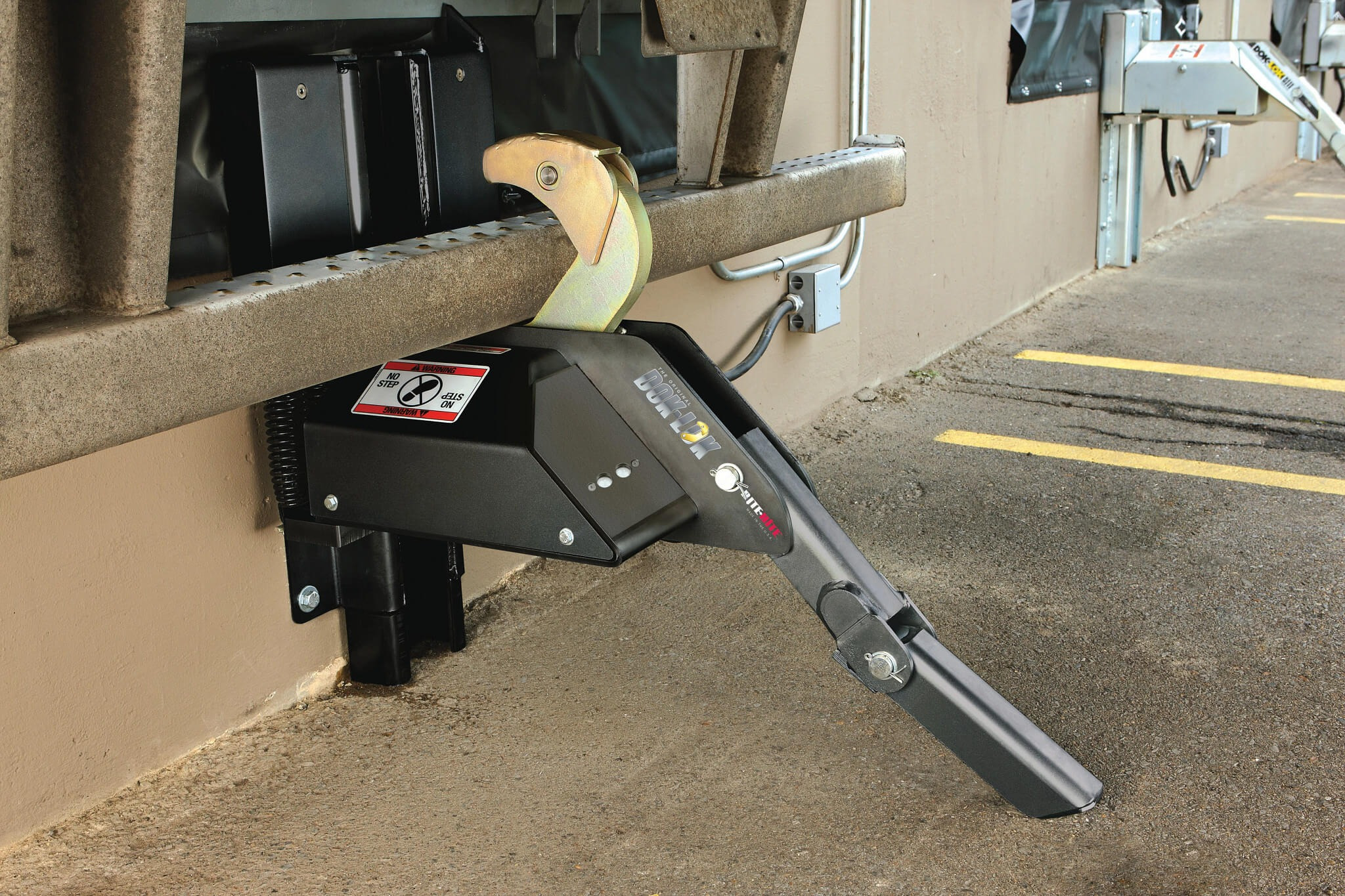
Rotating retaining hooks;
The hook pivots and its arm automatically engages under the RIG (for "rear impact guard"). As long as it is engaged, the truck cannot leave the dock.
The RHR-1100
The RHR-1100 offers a universal locking mechanism compatible with a wide variety of rigid rigs. Its removable faceplate facilitates upgrades to the Shadow Hook®, which creates a 12.7 cm (5 in) barrier for obstructed rigs and intermodal containers.
The Shadow Hook® SHR-5100
This third-generation hook locks the rear of the semi-trailer during handling and protects against premature departures. Its reinforced bearings and coated rail offer greater resistance to high-pressure points, particularly in the event of a forced removal attempt. Equipped with sensors, it counts cycles and signals trends and deviations, providing improved visibility into the loading process.
Vertical restraint barriers
The vertical containment barrier (VBR) rises and blocks the RIG from below, with a solid upward pressure. At Rite-Hite, it is 10.8 cm high and has an inverted conical profile.
This vertical barrier is ideal for direct loading when the tractor remains coupled: the fifth wheel acts as a counterweight and prevents any upward movement, so a hook is not required. It prevents premature departure, trailer movement, and accidental crossing of the platform.
Three models exist:
- on the ground (VBR-300 and VBR-350) : the VBR-350 is motorized, with reinforced cylinder and double wall rail with additional anchors;
- sub-leveller (VBR-600) : discreet, it does not clutter the workspace at the dock;
- wall-mounted (VBR-100) : compact, it takes up no floor space.
Wheel locking systems;
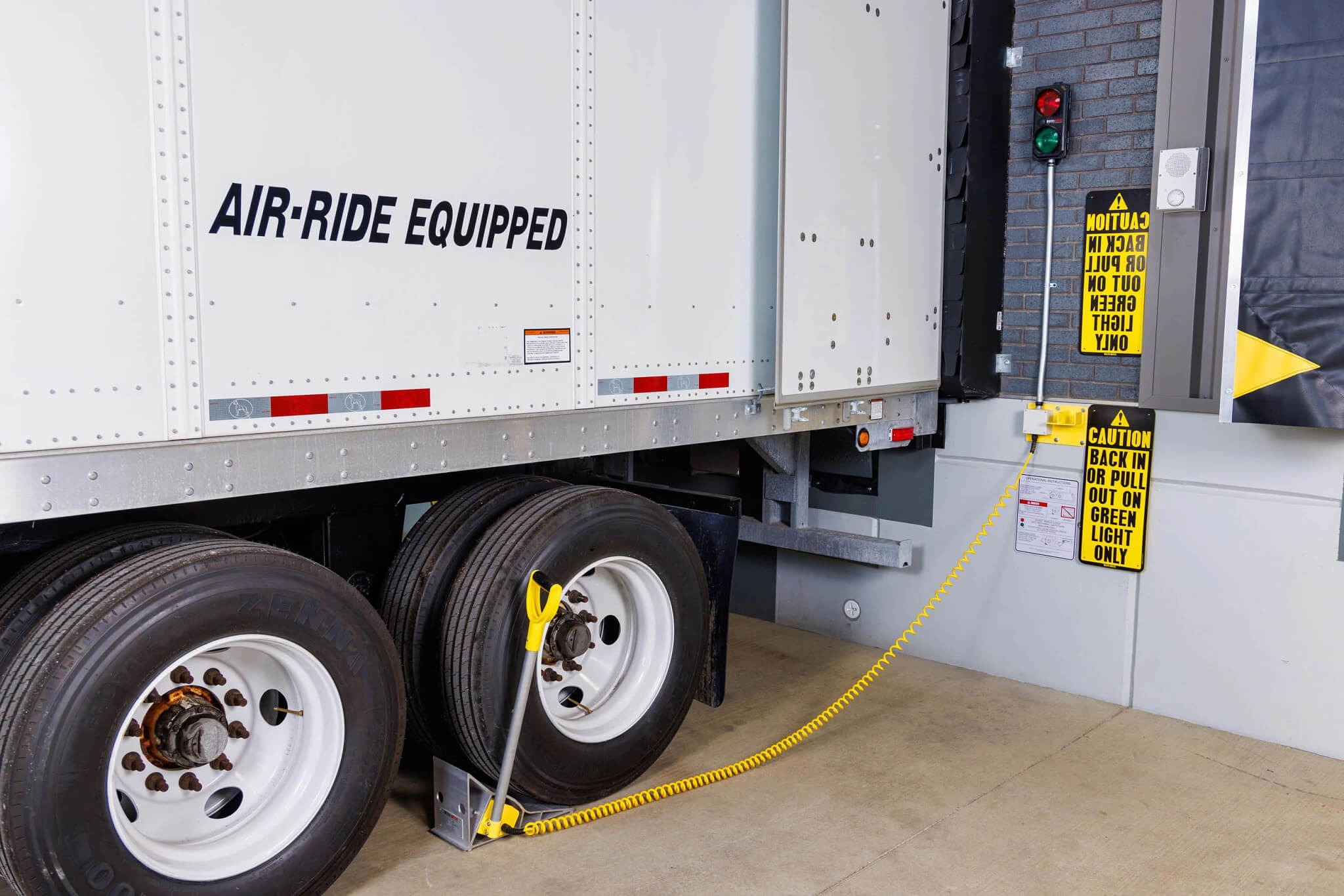
Some semi-trailers lack a usable rig: liftgate, intermodal chassis, damaged or missing impact bar. The rear tire lock solves this problem. It accommodates the widest variety of vehicles, including specialized models common in the food and beverage industry. Its guides also center the semi-trailer in front of the doors, thus improving sealing.
Global Wheel-Lok™ GWL-2300
This automatic surface restraint system uses the vehicle's energy to rotate a high-strength steel locking arm. It offers a wide restraint range, centered positioning, and good security for specialized vehicles.
Wheel-Lok™ MWL-1300
The manual and economical MWL-1300 requires minimal effort. An optional lock prevents accidental unlocking during operation. It is suitable for installations with low truck volumes.
GWC-1000 Global Wedge
The GWC-1000 is positioned manually. Its extra-long base maintains downward force, and an ultrasonic sensor confirms its position, facilitating communication with the dock. It's an affordable, basic solution.
How to choose between the different types of restraint devices?
Other criteria are important: manual or automatic system, floor or wall space, leveller type, number of vehicles per day, and internal safety standards and procedures. Dok-Lok® Controls or Dok-Commander® systems sequence the steps (restraint, door, leveller) to ensure staff follow procedures. Red and green lights facilitate communication between the forklift operator and the driver, indicating when to proceed safely. This visibility reduces the risk of accidents.
Installation and maintenance
Each installation depends on the platform design: height, leveler type, and clearance in front of the gate. The Canado Nacan team analyzes your docks and facilities before recommending a restraint system . Our service also includes the repair of restraint devices and other dock installations. A preventative maintenance program then ensures the protection of your equipment, reduces unexpected downtime, and prevents debris or worn parts from damaging the mechanism.
FAQ
Secure your docks
Are your trucks always leaving the dock on time? Speak to a Canado Nacan expert at 514-333-0077.
Subscribe and stay tuned
Stay up to date with our monthly security best practice newsletters.

