Category
Snow removal system
Which snow removal system should you choose for your fleet?


Frédéric Daniel Juneau
With more than 10 years of experience in the equipment field
Every snowfall leaves snow and ice on the roofs of your trucks and trailers. A detached ice pack on the highway is costly. So is a driver who has to shovel, and a delayed departure because the courthouse is blocked always ends up showing up in the weekly figures. Canado-Nacan's winter equipment clears the roof from the top, without anyone having to climb on. The model you choose depends on your fleet and your yard.
5 key points
- In Quebec, the Highway Safety Code prohibits allowing any material to detach from the vehicle being driven and driving a vehicle covered in snow or ice that could pose a danger to road users.
- Clearing snow from a trailer roof by hand is work at height: regulations require fall protection beyond 3 m (RSST) or 2.4 m (federal regulation).
- Scraper Systems™ Fleet Plow systems are divided into two families: either the fixed base on concrete footings, or the portable computer that is moved around the yard.
- Three levels of automation exist: manual control, standard automation with AutoUP™ sensor that raises the blade, and full OneTAP™ automation that positions and lowers the blade electronically.
- The type of vehicle dictates the model: trucks, trailers and vans on one side, buses and rounded roofs on the other, with series dedicated to wide aisles.
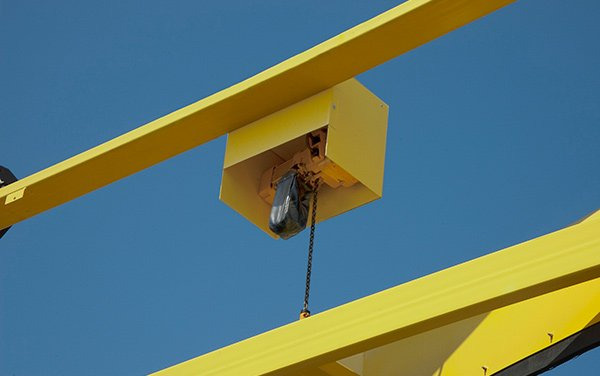
Why a mechanized system rather than an excavator?
What accumulates up there doesn't stay put. It slides when braking, lifts up at highway speeds, and ends up on the road behind you. Furthermore, the Highway Code prohibits allowing any material to detach from the vehicle you are driving, and driving a vehicle covered in snow or ice that could pose a danger to other road users.
Responsibility, however, is shared. The Ministry of Transport reminds us in its document on obligations relating to snow removal from heavy vehicles that the shipper, the operator and the driver each have their own: safe work methods, training, equipment provided, protection against falls from height.
A driver standing up there with a broom is a well-documented workplace accident scenario. A fleet system solves both problems at once: the vehicle moves forward, the blade scrapes, and no one leaves the ground.
Fixed or portable base
A fixed-base system is permanently anchored to concrete footings. This is the preferred choice for yards with predictable and high-volume traffic, as the snow removal station becomes a station that every vehicle passes through when entering or exiting. The 110S snowplow and its automatic version, the 110T , belong to this family. The 200 series , designed for wide trailers and available in widths of 20, 25, 30, and 35 feet depending on the driveway width, also falls into this category.
A portable system that moves. It's ideal for leased yards, sites with seasonal changes in layout, and smaller or seasonal fleets. The MD-12 is the entry-level model, designed for smaller truck fleets and snowfalls under 30 cm. The 440S takes ruggedness up a notch with standard automation, and the 440T adds full OneTAP™ automation. An optional portable power kit, featuring a 2,500-watt inverter generator and a protected platform, allows these models to operate without a fixed power connection.
Trucks and trailers, or buses;
The shape of the roof changes everything. The blades for trucks and trailers work on flat surfaces and clear both vans and delivery vans equally well.
The bus roofs are rounded and punctuated with hatches, lights, and uneven surfaces. The dedicated models (the portable 880B , the fixed-base 770B , and the 700 series for wide aisles) use a deep-V blade assembly that combines 10- and 14-inch brushes and 30-inch neoprene wipers, allowing them to navigate these obstacles without snagging. The height is continuously adjustable from 7'-2" to 14'-0", and the chassis provides a 4.47 m wide track. The 880B is the most capable, handling 60 cm of heavy, wet snow.
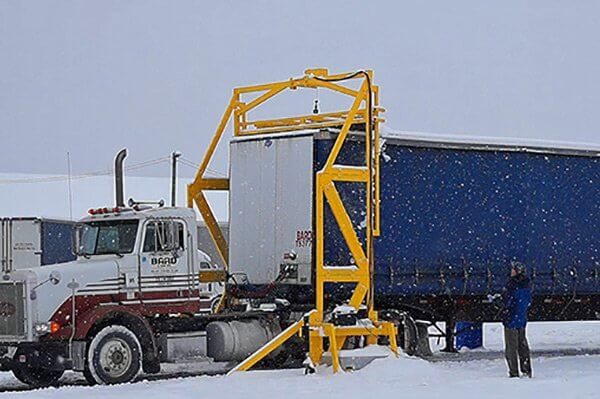
The level of automation
There are three levels, and it is often the volume of the courtyard that makes the difference.
The basic automation on the MD-12 is operated by manual control: the Deep-V™ blade is lowered to the correct position, the machine moves forward, and it is raised for the next one.
With standard automation , available on the 110S, 440S, and 200 Series, the AutoUP™ sensor takes over. The blade automatically retracts once the pass is complete, ready for the next truck.
The OneTAP™ full automation system , available on the 110T and 440T, takes this to its logical conclusion. The system locates the trailer, electronically lowers the blade to the precise position, signals the driver to move forward, and then raises the blade back to the raised position. In a yard where dozens of vehicles pass through each morning, this is where the time saved is truly measured.
Choose in three questions
- Which vehicles? Flat roofs, or rounded roofs on buses and vans?
- What kind of yard? Permanent anchoring on concrete footings, or equipment to be moved? What width of driveway, up to 35 feet?
- What volume? A few units per day, or a whole fleet to get through before the morning departures? It's the volume that justifies OneTAP™.
Dealer installation is required for several of these systems, and the Rite-Hite service network covers North America.
FAQ
Take action
Have your yard assessed before the first snowfall. Speak to a Canado-Nacan expert and leave with the model that matches your fleet, your driveway, and your volume.
Subscribe and stay tuned
Stay up to date with our monthly security best practice newsletters.