Category
Security
Our restraint hooks: excellence at the service of the safety of your docks


Safety on a loading dock is a priority in any successful industrial company. To ensure this, specific equipment is required to maintain total control and rigorous protection. Discover the models of retaining hooks that you can find at Canado-Nacan Équipements.
Key points to remember
- Accident prevention : Hooks immobilize trailers during loading and unloading.
- Three suitable technologies : Vertical barriers, rotating hooks and wheel locks for all vehicles.
- Solutions for complex cases : Wheel-Lok secures trailers with tailgate or low chassis.
- Intelligent communication : Dok-Commander and Rite-Vu coordinate equipment and personnel automatically.
- Rite-Hite Expertise : 40 years of Canada-Nacan experience and recognized sustainable technologies.
Restraint hooks help prevent serious accidents during the loading and unloading phases. It stabilizes the vehicle and prevents any unplanned movement that could endanger your employees. By securing the connection between the truck and the dock, these systems ensure smooth and risk-free productivity .

Vertical barriers
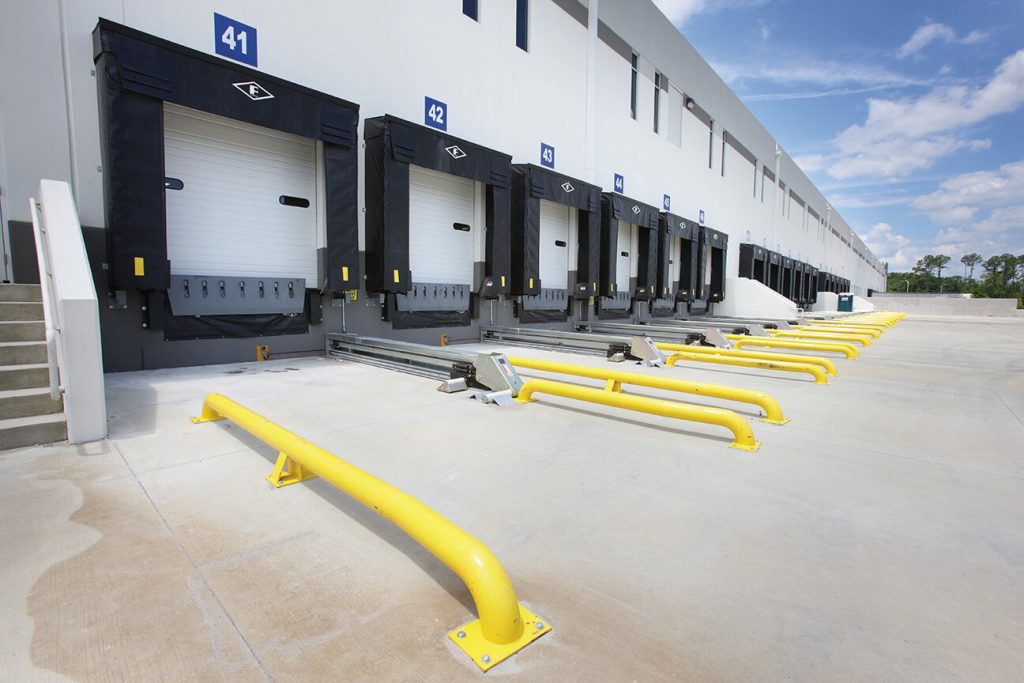
Our vertical barriers provide robust protection against the risk of accidental separation. This equipment reduces the risk of accidents caused by unexpected trailer departures and the costs associated with work stoppages. This force effectively stabilizes the vehicle, thus avoiding premature departure or gradual advance of the truck.
We offer three Rite-Hite models tailored to your specific needs:
- The VBR-100 is a reliable and easy-to-install wall-mounted solution.
- The VBR-300 is installed directly on the ground with an inverted bevel design, for added protection. This unique shape ensures maximum grip on the vehicle's safety bar.
- The VBR-600 is recessed under the pit for total discretion and formidable efficiency.
This equipment is built to last and withstand the most demanding conditions.

Rotating hooks
Rotating hooks represent the most advanced technology for securing trailers on the market today. Their unique design allows the vehicle chassis to be securely gripped with precise rotational motion.
The SHR-5000 model is distinguished by its "Shadow Hook" technology. This system makes it possible to secure even the most complex multimodal container chassis .
The GRH-700 , on the other hand, relies on exemplary simplicity for minimal maintenance and constant reliability.
For companies looking for total stability, the STR-4200 is the ideal solution. It drastically reduces vertical and horizontal movements when forklifts pass through. This stability not only improves safety, but also extends the life of your dock equipment.
Wheel lock restraint systems
Some truck configurations do not allow the use of a conventional hook on the underride bar. This is the case for trailers with hydraulic tail lifts or low-floor chassis. For these situations, we offer the Wheel-Lok™ range, which acts directly on the vehicle's wheels.
The GWL-2300 model is fully automatic and uses the truck's energy to lock the rear wheels. This wheel lock restraint system fits almost any tire size for exceptional versatility.
If you prefer more direct management, the MWL-1300 is a high-performance manual option. This device is easy to handle and guarantees perfect immobilization for a wide variety of fleets. It is the ideal alternative to secure every dock position, regardless of the type of truck.

The communication and control system
Efficient restraint equipment must be accompanied by clear communication between drivers and staff.
The Dok-Commander® smart box centrally manages all your security devices at every door. It allows equipment to be interlocked to ensure that it is used in the correct order. This virtually eliminates the risk of human error when manoeuvring.
In addition, the Rite-Vu™ indicator light system provides full visibility into the security status. Visual signals, such as the Pedestrian-Vu, warn staff when a truck is driving inside a trailer. Outside, the Approach-Vu uses audible and visual sensors to protect pedestrians from approaching trucks. This perfect coordination creates a highly secure and reassuring working environment for your teams.
Complete solutions for your loading docks
At Canado-Nacan Équipements, we transform your loading area into a safe and productive work environment. Our comprehensive offer, ranging from vertical barriers to intelligent communication systems, meets every logistical challenge.
By choosing our restraint solutions, you protect your employees while optimizing your daily operations. We put more than 40 years of expertise at your service to advise you on the best Rite-Hite equipment.
Ready to secure your installations with experts? Contact us today for a personalized assessment of your needs.
FAQ
Subscribe and stay tuned
Stay up to date with our monthly security best practice newsletters.