Category
Fall prevention
Your loading dock just broke down, now what?


A levelling bridge that refuses to go down. An industrial door stuck halfway up. A restraint hook that no longer holds the trailer in place. This kind of breakdown always happens at the worst time, in the middle of a loading period, never when the schedule is quiet. Here's how to react quickly, who to call, and what to prepare to make the intervention go smoothly.
Key points to remember
- Faulty dock equipment can interrupt your operations in minutes
- 24/7 emergency service minimizes time and productivity losses
- Manufacturer-certified technicians ensure proper repairs
- Preparing certain information before the call speeds up diagnosis
- A well-done repair also protects the safety of your teams
What a Dock Break Really Means for Your Operations
A loading dock is not a single piece of equipment in isolation. It is a system where the leveling bridge, door, restraint and signaling work together. When one of these elements fails, the risk does not disappear. It simply moves to the weak point of the installation.
This is confirmed by the investigations carried out after accidents at transshipment wharves in Quebec. A disconnected restraint system or improperly maintained equipment can have serious, sometimes fatal, consequences when moving a trailer while a worker was in the wedge area between the dock and the vehicle. An equipment breakdown is therefore only ever a question of productivity. It's also a question of security, and the two often go hand in hand.
What Signs Should Call Now
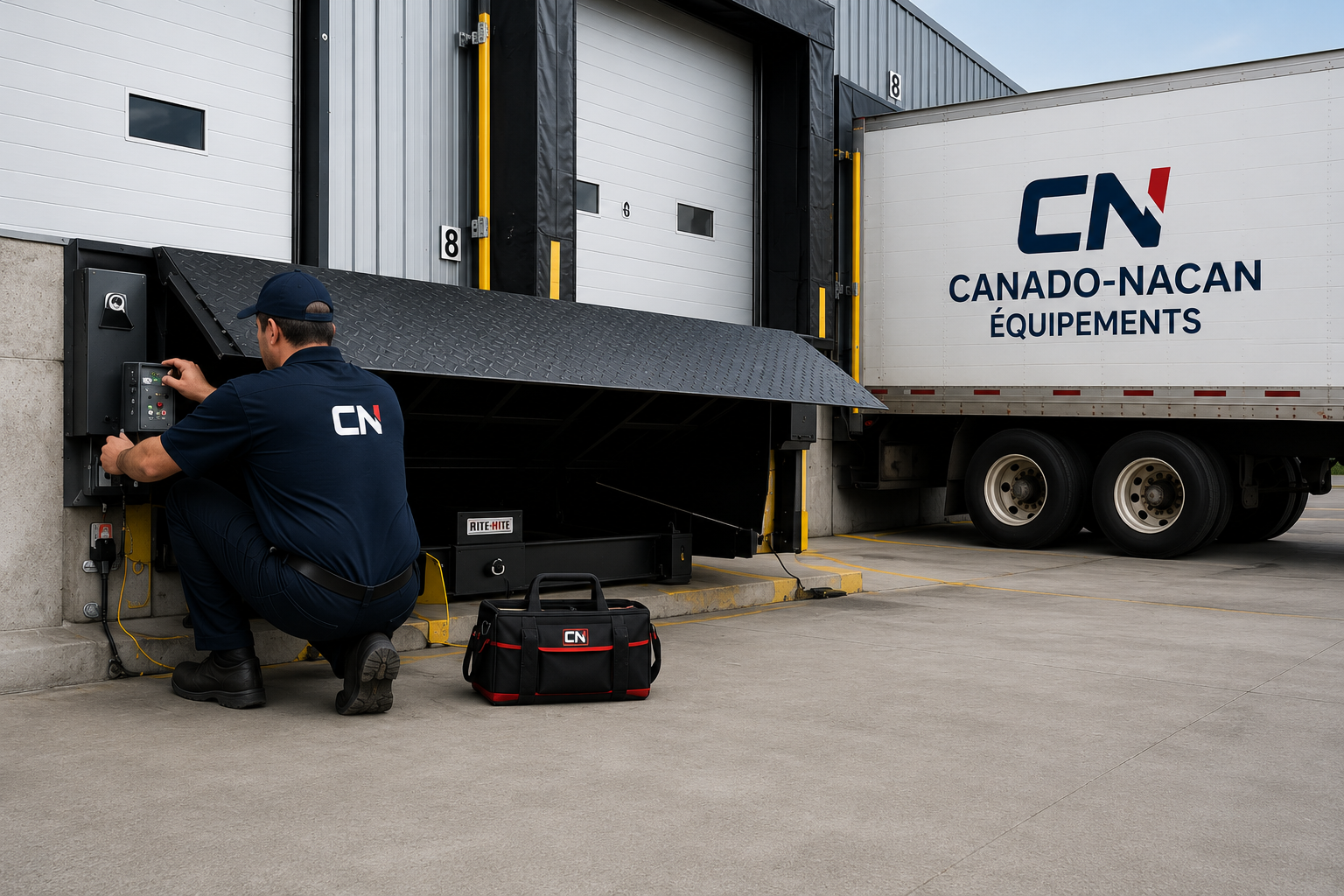
Some situations do not tolerate any delay. A levelling axle that is locked in the high or low position prevents loading. A hook or restraint that no longer engages properly puts safety at risk. An industrial door that refuses to close, abnormal noise, a hydraulic leak or an irregular movement of the equipment are also signs to be taken seriously.
In all these cases, the first step is simple: stop using the defective equipment, even before dialing the service number.
What to prepare before dialing the number
An effective service call starts with a few pieces of information in hand. This avoids unnecessary back-and-forth and speeds up the technician's diagnosis. It is helpful to have the type of equipment affected, whether it is the leveler, door or restraint system, as well as its serial number if available, on hand. The door number or the exact area where the equipment is located, along with a clear description of the problem observed, completes the information to be transmitted.
Common mistakes to avoid
Continuing to use faulty equipment while waiting for a repair is probably the most common mistake. Attempting a homemade repair on a complex hydraulic or mechanical system is another, and it can make the problem worse rather than fix it. Delaying the appeal in the hope that the situation will resolve itself usually only makes things worse. And ignoring a restraint system that seems to be working, but doesn't fully engage, is like ignoring the most important signal.
What to do concretely
If the equipment poses a hazard to workers or blocks a critical operation, the immediate action is to stop using it and call emergency service. If the break affects only a secondary dock and operations can continue elsewhere, simple monitoring is sufficient until intervention during normal business hours.
For any technical diagnosis, any hydraulic or mechanical repair, or any return to compliance, a technician certified by the manufacturer remains the best option to guarantee a durable and safe job.
Prevention rather than repair in an emergency
A scheduled maintenance schedule significantly reduces the number of unscheduled service calls. Regularly inspecting restraint systems, checking the condition of seals and hydraulic components, and training crews to recognize signs of failure are small habits that prevent unplanned downtime.
Staying in control
An equipment breakdown at the wharf is not exceptional in an active logistics operation. What makes the difference is the speed and quality of the intervention. With a team of certified technicians available at all times, no one has to manage this emergency alone.
Need help assessing your situation?
If you're unsure of the severity of the issue or what to do next, our team can help you understand your options and determine next steps.
Contact us for any equipment safety questions.
Frequently asked questions
Subscribe and stay tuned
Stay up to date with our monthly security best practice newsletters.