


Category
Energy saving
Improving industrial safety: why a practical visit is better than a catalogue

Every industrial company has a procedures binder. Almost all of them also have a loading dock where reality deviates from the procedures: a wheel chock that's no longer used because it takes too long, a sensor bypassed, a door left open in winter because it's too slow. Improving industrial safety, therefore, is less about writing a new rule than about changing equipment so that the correct method becomes the easiest.
A catalog never shows that. A technical datasheet provides a capacity, a standard, a cycle time. The question remains whether the operator will bypass the device on the third truck of the morning. That's exactly what the Canado-Nacan site visit allows you to verify: our installations and solutions observed in real-world operating conditions, with the people who use them every day.
Key points
- Industrial safety is judged in real-world use : a device that personnel bypass does not protect anyone, regardless of its technical specifications.
- A hands-on visit combines two things that a showroom cannot offer : a demonstration of the equipment in operation and testimonials from employees who use it.
- The most costly risks at the loading dock are known and avoidable : premature departure of the truck, forklift fall, uneven ground, pedestrian traffic poorly separated from vehicles.
- The visit informs your security investments and directly feeds into your risk assessment and prevention program, with dated observations to support it.
- An investment in safety is better justified when it's quantified : maneuvering time, incidents avoided, energy losses, downtime. The inspection provides these figures.
What a technical datasheet will never tell you
Two restraint systems can have the same capacity but behave very differently in your building. The real question goes beyond compliance: will your employees use it correctly with the hundred or so trucks per week, in January, carrying trailers from various fleets?
This is where written safety rules most often fail . An industrial safety system holds true when the safe method is also the fastest method. When it adds forty seconds per truck, a workaround emerges, and it becomes ingrained long before it appears in a report.
Observing equipment in operation resolves the issue in minutes . You see the complete sequence, from the mooring signal to the green light, and you see if the personnel follow it or bypass it.
What you observe during a practical visit
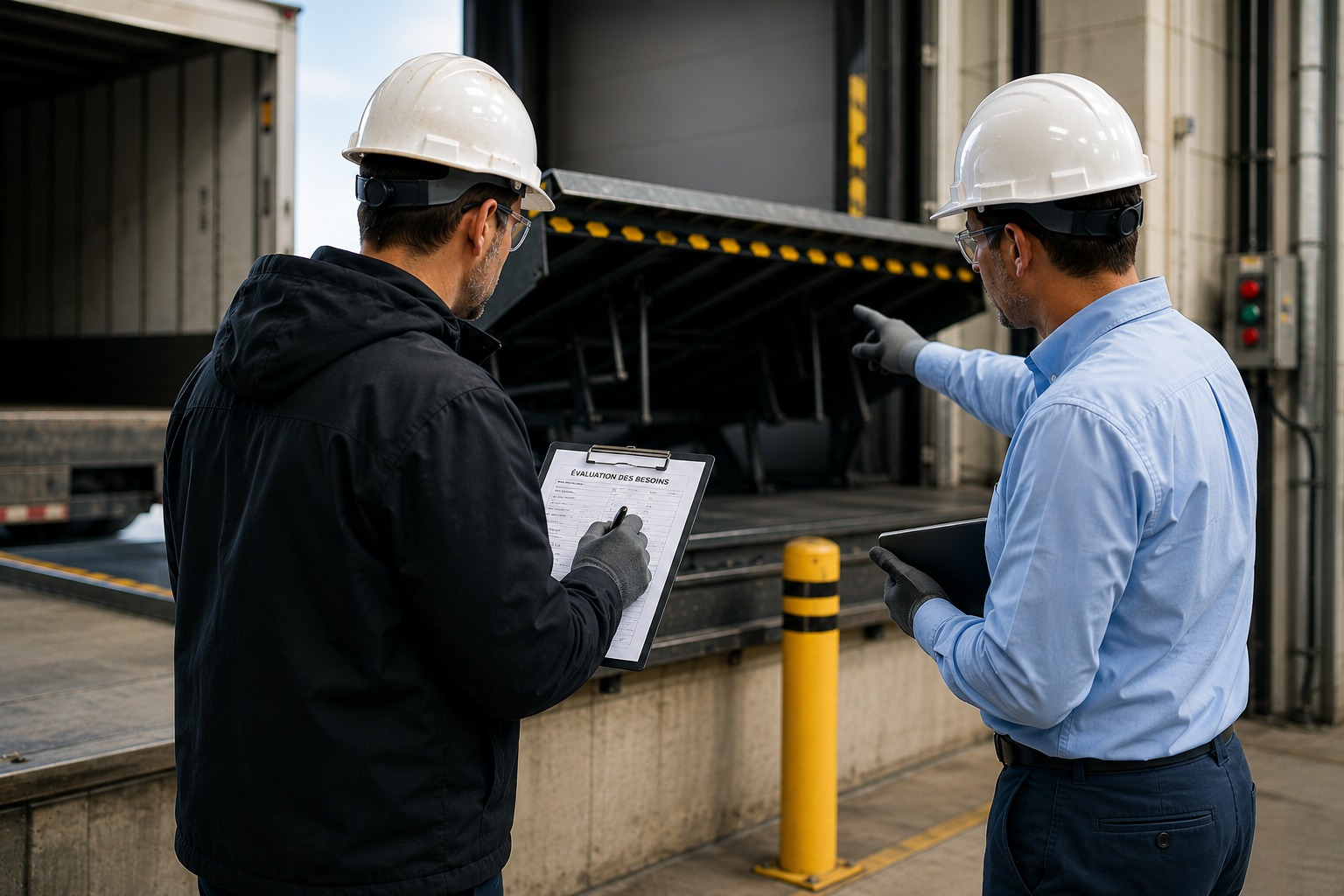
A practical visit is more like a guided observation session in an active work environment than a product presentation. You look at four things.
The first step is the vehicle restraint sequence . Time it. A mechanical restraint system properly integrated with the traffic light and dock leveler creates a sequence where the forklift operator has no decisions to make: the truck is stopped, the signal turns green, and loading begins. This is the best way to eliminate premature departure, one of the most serious accidents on the loading dock.
The second component is the dock leveler . Its condition can be seen in the pit, the wear on the lips, and the presence of water or ice, and its noise is a telltale sign. A poorly managed difference in level between the platform and the trailer is a classic cause of forklift rollovers.
The third is waterproofing and environmental control . From inside, with the trailer docked, look for daylight around the cushion. What appears to be an energy loss is also a risk: wet floor, ice on the ground, condensation.
The fourth is traffic flow . Where do pedestrians go? Where do forklifts go? Floor markings, a physical barrier and a well-positioned speed gate separate the flows much more effectively than three awareness signs.
Talk to the employees who use the equipment
The most valuable part of a visit is often poorly planned. It's the conversation with the teams who use the products on a daily basis: forklift operators, maintenance staff, safety managers.
Three questions almost always elicit frank answers: What has changed in your routine since installation? What bothered you during the first two weeks? What breaks and how often?
The responses highlight the real pain points : the underestimated maintenance, the retraining required, the spare parts that need to be kept in stock. No brochure or technical specification contains this kind of feedback. It prevents you from buying technically excellent equipment that won't outlast your organization. It also provides an opportunity to assess the quality of the installation and maintenance services behind the product, a factor that has a greater impact on its lifespan than the technical specifications alone.
Observations that inform your risk assessment
In Quebec, employers must ensure a safe work environment, and the Regulation respecting occupational health and safety requires, among other things, that all motor vehicles be used, maintained, and repaired in a way that does not compromise the health and safety of workers. The CNESST (Commission des normes, de l'équité, de la santé et de la sécurité du travail) intervenes in these matters, and its inspections focus on the measures actually implemented on the shop floor. Beyond Quebec, Government of Canada agencies also publish industrial safety requirements, and all these obligations are addressed in the same place: within the building itself, not in a document.
A site visit produces precisely the kind of material these requirements demand: concrete, dated observations comparable to your own situation. In France, industrial safety management is based on this logic of demonstrable measures. You therefore note what works at a comparable operator, what has been corrected after an incident, and what you have not yet addressed.
Leave with a three-column checklist : the observed risk, the corresponding technical measure, and the discrepancy with your building. This is directly usable material for a prevention program.
What new technologies change, and what they don't change
The loading dock industry has evolved significantly : automated restraint devices, presence sensors, high-speed doors, automated traffic light sequences, and traffic management systems. These technologies make a real difference, provided they remove a decision from the operator's workload instead of adding a step.
A site visit allows you to determine this precisely . You see if the innovation presented at the trade show holds up after the twentieth truck, and you hear what the employees think after two winters. A continuous improvement strategy is built there, sector by sector, position by position.
Canadian businesses don't all start from the same point, and neither do their sectors: agri-food, cold storage, auto parts, retail distribution. The same equipment circulates across the country, but winters, volumes, and truck fleets differ. Therefore, implementing an improvement must keep pace with your actual growth : a loading dock sized for the volumes of ten years ago becomes a point of risk as soon as the number of trucks increases. In manufacturing companies as well as distribution centers, the most significant gains come from a simple, well-integrated sequence that no one wants to bypass, more often than from the latest gadget.

The safety culture is evident on the platform.
A company's safety culture can be assessed in fifteen minutes on a loading dock. Are the wheel chocks stored in their proper place or piled up in a corner? Is the floor marking freshly painted? Does someone stop you when you cross a traffic area?
Also, pay attention to who's speaking. If the operations manager lets the forklift operators answer without correcting them, employee engagement is genuine . If no one dares to contradict the boss, the company's safety indicators are probably worth less than they appear.
Ultimately, what you're visiting is an organization that has either succeeded or failed in getting this equipment adopted. Both pieces of information are useful to you.
Translating security into defensible figures
Investments in industrial security are better received when they are quantified, and a visit provides these figures.
Note the truck maneuvering time before and after installation, if the operator measured it. Ask for the number of incidents and near misses reported in the last twelve months. Ask for the change in heating bills since the doors were replaced. Ask for the number of service calls per year and the average downtime.
Four figures are all it takes to build a case . Safety investments can then be compared like any other capital project, with a return on investment and a risk mitigated. For management, the case is self-contained: a measurable investment to strengthen employee protection and business continuity. A growing company has everything to gain by resolving these issues before adding shifts, because increased volume amplifies every weakness in the loading dock. Productivity gains pay for the equipment, and risk reduction protects against costs that only surface after an accident: compensation, investigation, production downtime, and increased insurance premiums.
Practical visit, demonstration, needs assessment: three different things
The demonstration shows how a piece of equipment works, often. The needs assessment analyzes your building, its dimensions, and constraints to define the solution. The practical visit, on the other hand, puts you in front of solutions already in operation, with their users.
The most effective order begins with a needs assessment to define the problem, continues with a practical visit to validate the approach, and ends with a demonstration to decide between two configurations. Each one answers a different question .
A common misconception is that this is related to industrial tours open to the public. Here, we are watching a dock in operation.
What needs to be prepared to make the visit useful?
Put your own loading dock on paper before you leave. Include the number of doors, height, type of trailers received, daily truck volume, temperature differential to maintain, and any incidents from the last two years. This will allow for a comparison between the facility you're visiting and your own.
Next, choose three priority irritants and only visit to address them. A visit that tries to cover everything solves nothing.
If possible, come in a group of three : the decision- maker, the dock operator , and the maintenance worker . They won't all notice the same details, and the difference in their observations is often the most informative part of the day. As for personal protective equipment, bring safety shoes and, depending on the site, a helmet, safety glasses, and a safety vest, as well as a stopwatch and a measuring tape.
FAQ
See our solutions in action before you invest
Canado-Nacan Équipements , a leader in industrial safety in Quebec, organizes practical visits where our loading dock equipment and industrial doors are observed in real-world conditions. Bring your concerns, leave with concrete solutions.
Contact us to schedule a practical visit or speak to an expert
Subscribe and stay tuned
Stay up to date with our monthly security best practice newsletters.

